|
The research is sponsored by:
|
The project
Nearly each summer since 1981 fieldwork has been caried out to investigate the peregrine falcons in South Greenland.
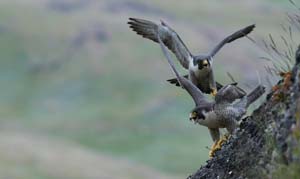
The study has focused on population density, territory occupancy, production of young, prey selection, nest-site selection,
monitoring of pesticide contamination, reduction in eggshell thickness and phenology in relation to climate change.
From 2023 a process for transferring know-how and data to Pinngortitaleriffik (Greenland Institute of Natural Resources) has been initiated,
thus achieving an institutional home for the project. This will hopefully assure future datacollection. This process is supported by a grant from Aage V. Jensens Fonde.
|
