Photos on this website may be used for newspaper and other articles on this project if appropriately attributed.
All photos have been taken durring fieldwork in South Greenland.
 |
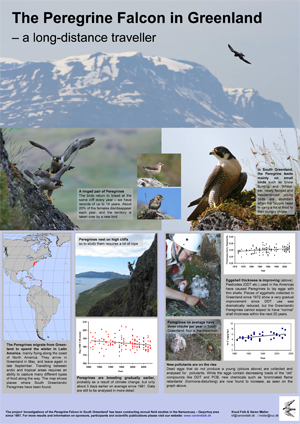
Poster describing the project. [Download] |
 |
Typical peregrine cliff in South Greenland. [Download] |
 |
On the way to a peregrine nest ledge. [Download] |
 |
On the way to a peregrine nest ledge. [Download] |
 |
Nest with broken eggs and a single adled egg. This material was collected and analyzed. High concentrations of pollutants leads to thin shells raisning the risk of broken eggs. [Download] |
 |
Collecting egg shell fragments. [Download] |
 |
Hatching eggs. [Download] |
 |
Three young at age app. 14 days. Three is the average clutch size for peregrines in Greenland. [Download] |
 |
Ascending the rope on the way back from the nest ledge. [Download] |
 |
Hatched eggs leave a number of egg shell fragments in the nest. From 1981 to 2003 samples have been collected from nearly all visited nests. Their thickness can then be measured by a digital micrometer. This method is an important supplement to the chemical analyses as thickness is related to load of DDT and other chemicals in the mother bird. [Download] |
 |
The collected addled eggs are prepared for chemical analysis. The analyses are done by the National Environmental Research Institute in Roskilde. [Download] |
 |
Adult peregrine falcon (male). The peregrines breeding in Greenland migrates along the Northe American east cost to winter in Central and South America. [Download] |
 |
Adult peregrine falcon (female). [Download] |
 |
Adult peregrine falcon. In Greenland the peregrines primarily prey on passerines. [Download] |
 |
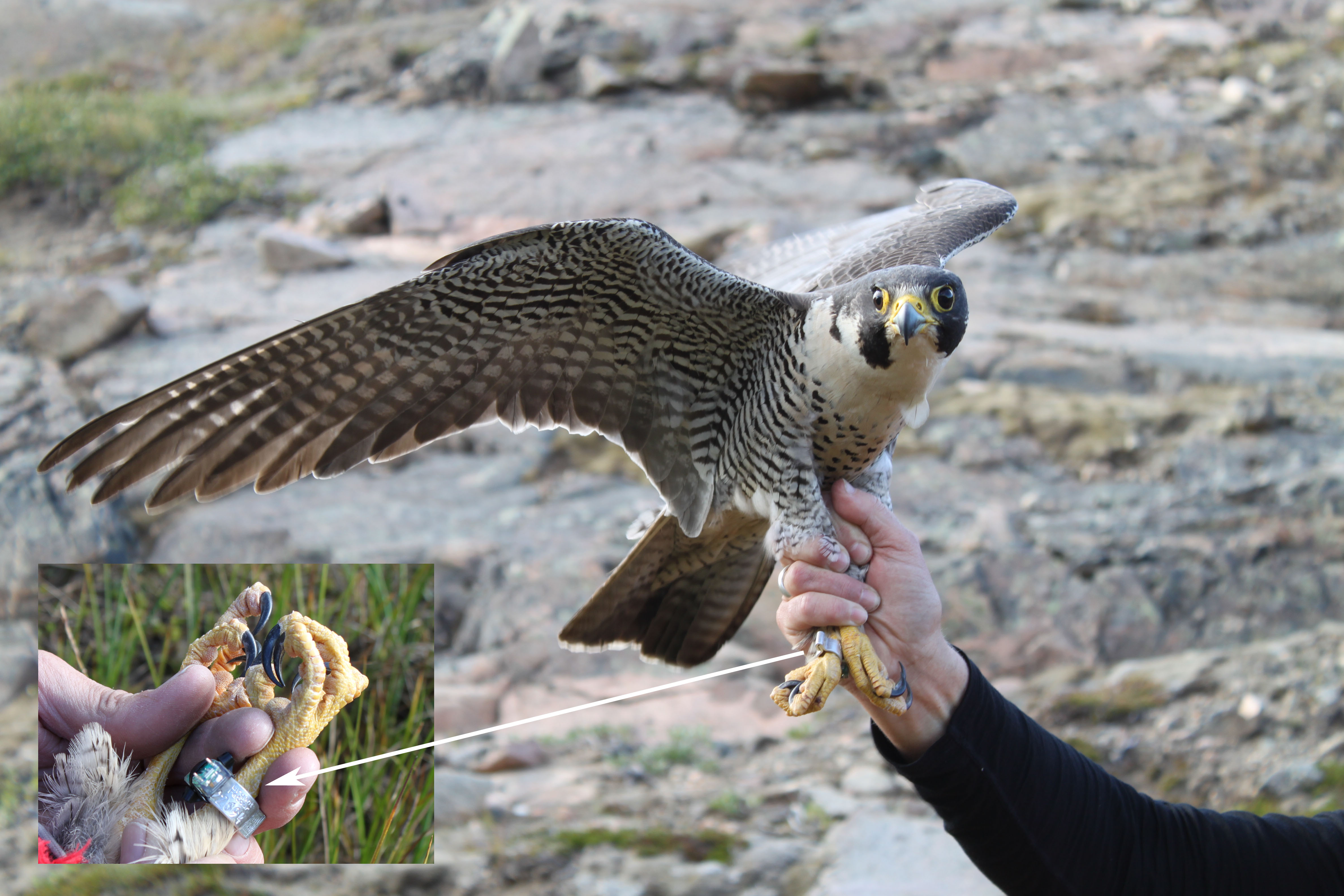
Adult peregrines, male and female. Both birds are banded. [Download] |
 |
Peregrine falcon (female). [Download] |
 |
Newly fledged peregrine young. [Download] |
 |
Peregrine captured to be banded. [Download] |
 |
Søren Møller and Knud Falk. © Lena Hansson. [Download] |
 |
Knud Falk and Søren Møller. © Lena Hansson. [Download] |